
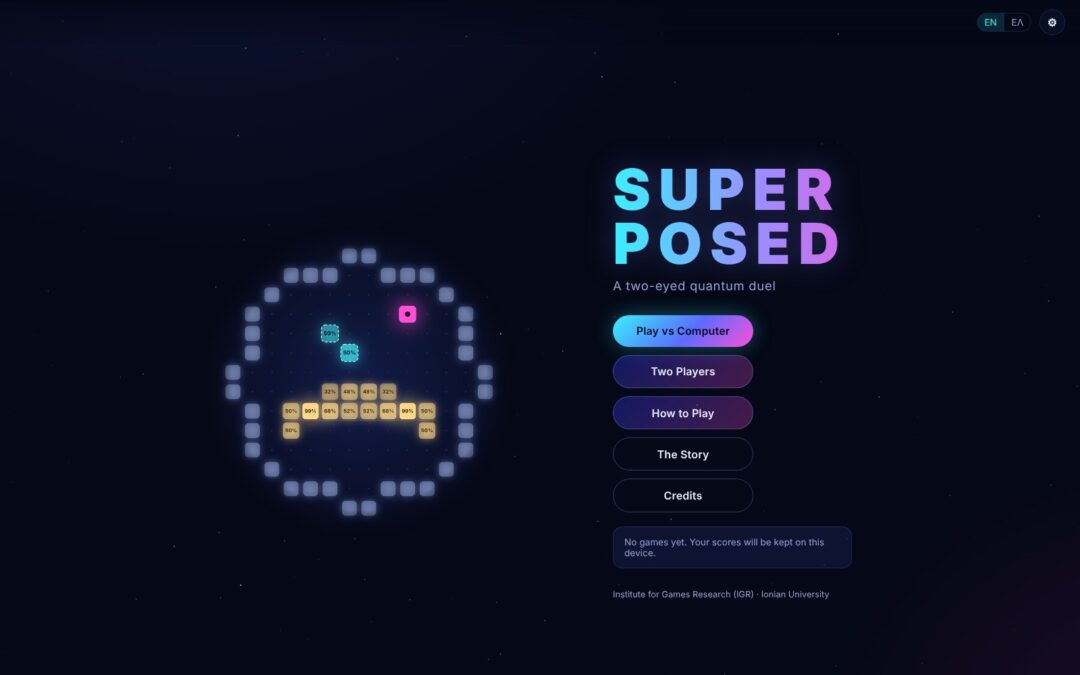
The Institute for Games Research (IGR) / Ερευνητικό Ινστιτούτο Παιχνιδιών (ΕΙΠ) of the Ionian University has released Superposed, a two-player game whose rules are taken from quantum mechanics. It is playable in the browser now, in English and Greek, against the computer or against a friend on the same screen.
The explainer video (2:37, English narration with Greek subtitles) shows a game on the board and what the quantum computer does at each step.
From quantum art to a game. The project started as an art experiment. Small greyscale pictures were loaded into the amplitudes of a few qubits, transformed with quantum gates and read back from thousands of measurements, first on an emulator and then on the Quantum Inspire platform of QuTech in Delft. The test image was a sad face, and the task was to make it smile. We compared three ways of doing it: swapping rows of pixels, moving pixels in two stages through a straight line, and driving the mouth from a parabola equation. The last one turned out to be the cleanest, and its mouth is the one that lives on in the game.
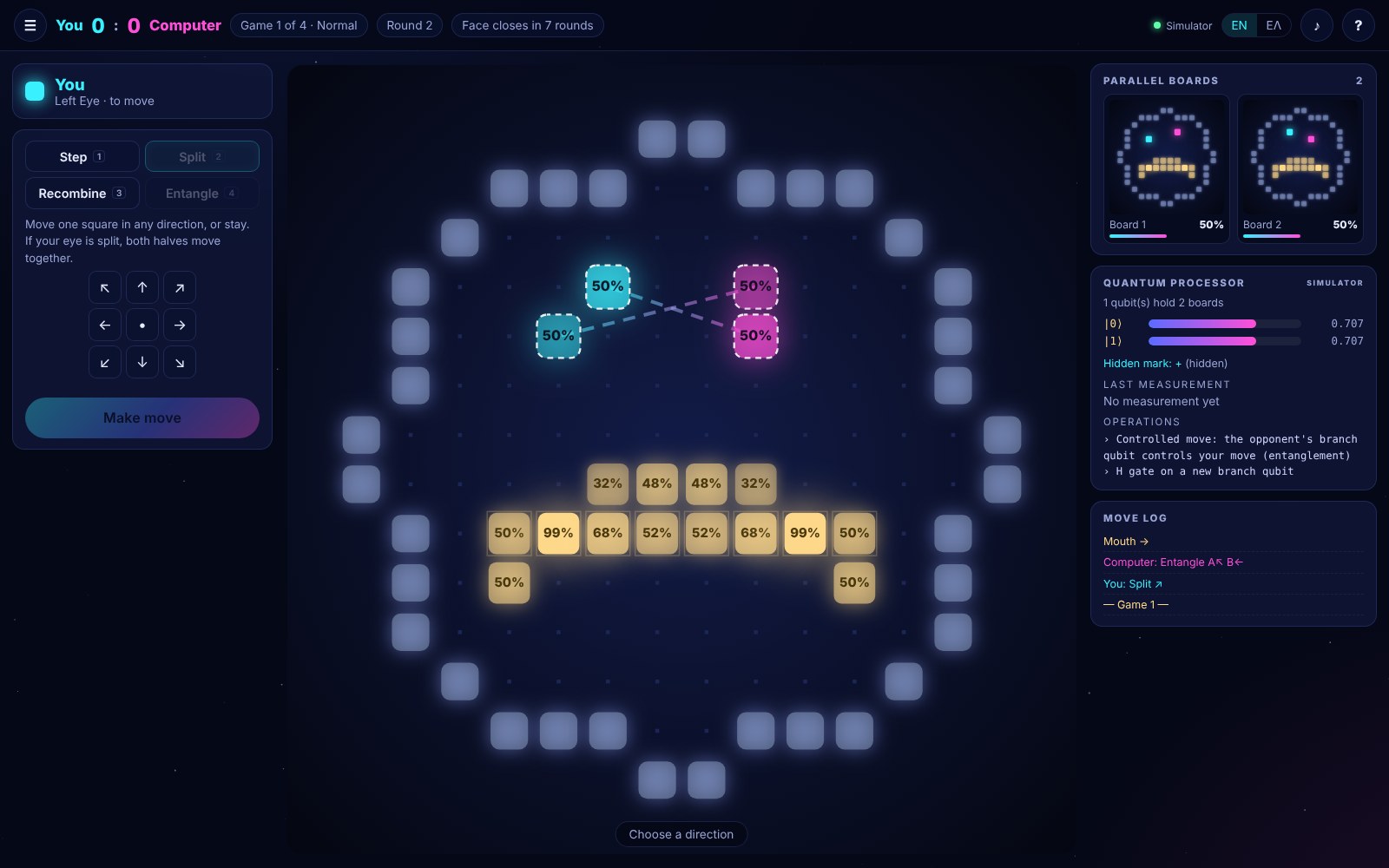
How the game works. Each player is one eye of a 16 × 16 face. The mouth keeps moving between a frown and a smile, the face shrinks every eight rounds, and the first eye to touch the other wins. What makes it a quantum game are three moves. A split puts an eye in two places at once, so the game continues on parallel boards that are all played together. A recombine brings the two halves back so that they interfere; a hidden mark, which the opponent cannot see, decides where the eye lands. An entangle move ties the two eyes, so a choice on one board means a different move on the other. Nothing is decided until it must be. When a touch or a catch happens on some boards but not on others, the position is measured and a single board becomes real, with the odds the game has shown all along.
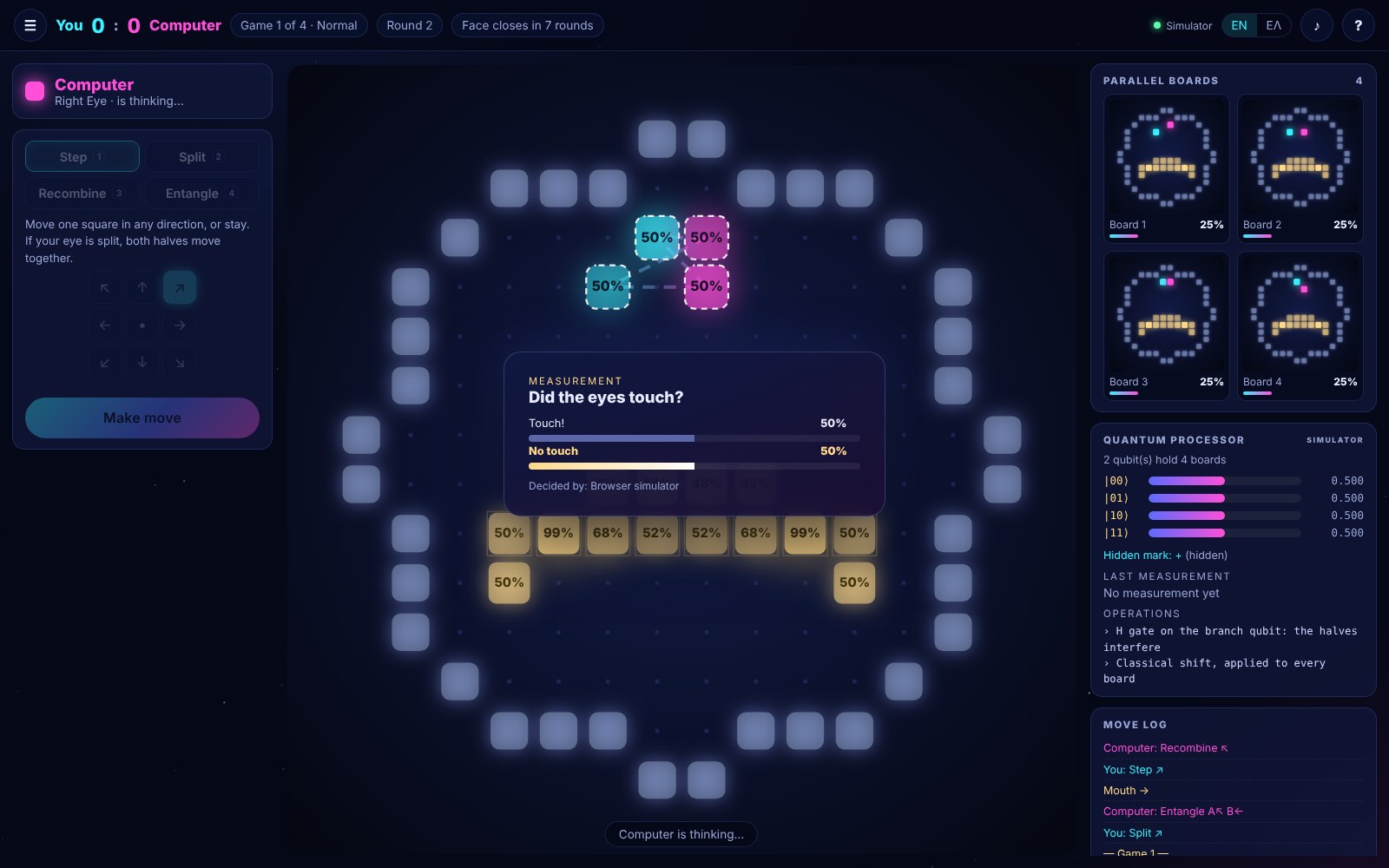
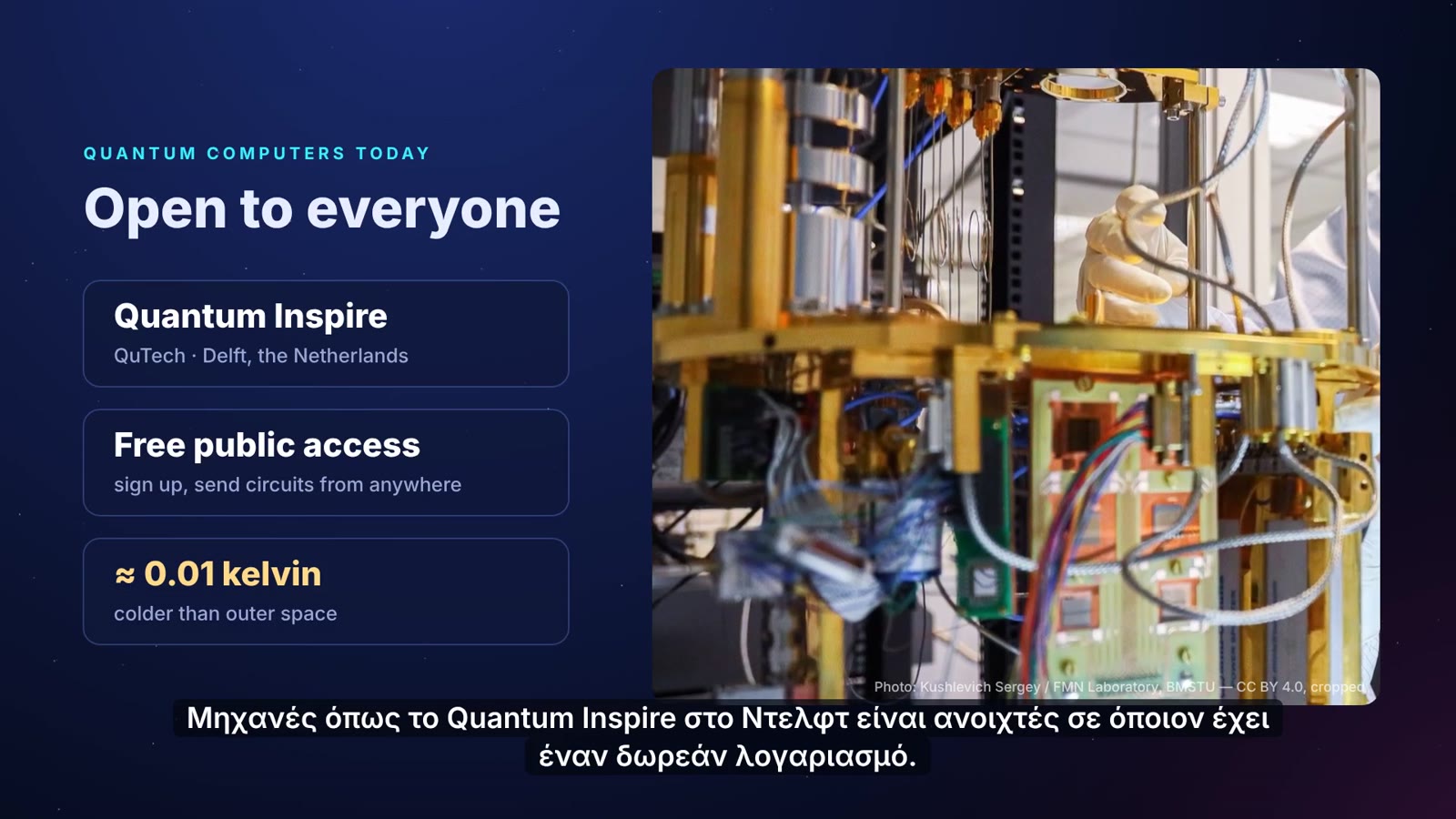
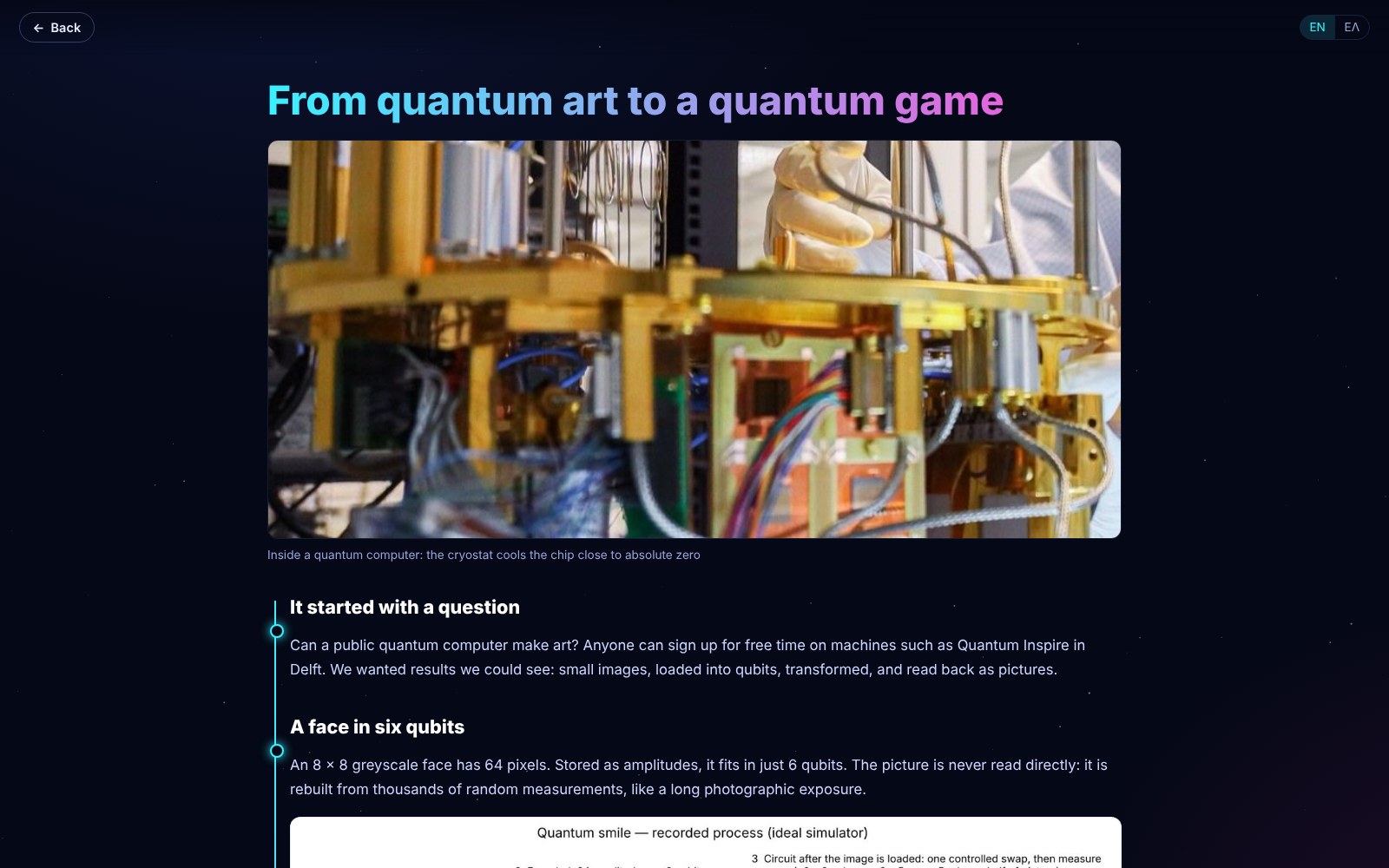
Simulator or real quantum computer. In the browser the game runs an exact quantum simulator, so it works anywhere. Every split, recombination and entanglement is a quantum operation on a small qubit register, and every decision is a measurement. Players who have a free Quantum Inspire account can run a small bridge program on their own computer; the game then sends each measurement to Quantum Inspire, to a real quantum chip when one is online and to the QX emulator otherwise.
What is in the release. One-player mode with three computer levels, two-player mode on one screen, matches with alternating starts, an illustrated introduction, a rules and moves card, a score record, a page on how the project grew from quantum art to a game, and full credits.
Why it matters for research. Superposition, interference, entanglement and measurement are hard to explain and easy to misread. In Superposed players use them as tools and see their consequences on the board, which makes the game a useful object for studies of learning through play and for game design research on turning a scientific model into rules. We welcome colleagues who want to use it in teaching or in studies.
Play Superposed in the IGR Game Gallery →
Superposed is a game by Yannis Deliyannis, Institute for Games Research (IGR) / Ερευνητικό Ινστιτούτο Παιχνιδιών (ΕΙΠ), Department of Audio and Visual Arts, Ionian University. Quantum computing: Quantum Inspire by QuTech (TU Delft & TNO).